News and Articles

Soundproofing and Thermal Insulation Benefits of Ecowall by Sristi Ventures

Ecowall by Sristi Ventures is an insulated wall panel system designed to provide excellent thermal insulation, faster construction, and improved indoor comfort. With its EPS (Expanded Polystyrene) insulated core, Ecowall offers an energy-efficient and lightweight wall solution for residential, commercial, industrial, and prefabricated buildings.

Thermal Insulation Benefits

EPS is an excellent thermal insulator because it contains about 98% trapped air.

Key benefits:

  • Low thermal conductivity: Typically, 0.032–0.038 W/m·K, reducing heat transfer.
  • Energy savings: Can reduce cooling and heating energy consumption by 20–50%, depending on the building design and climate.
  • Comfortable indoor temperatures:Helps maintain stable indoor temperatures throughout the day.
  • Reduced HVAC load: Air conditioning and heating systems operate more efficiently.
  • Moisture resistance:EPS absorbs very little water, so its insulating performance remains stable over time.

Typical thermal resistance (R-value):

EPS Thickness Approximate R-value
50 mm

75 mm

100 mm

150 mm
1.3–1.6 m²·K/W

2.0–2.4 m²·K/W

2.6–3.2 m²·K/W

4.0–4.8 m²·K/W
Greater thickness provides better thermal insulation.

Sound Insulation Benefits

EPS is not primarily an acoustic material, but sandwich panels can still provide moderate sound reduction.

Typical sound reduction (STC/Rw):

Panel Type Typical Sound Reduction
50 mm EPS sandwich panel

75 mm EPS sandwich panel

100 mm EPS sandwich panel
22–28 dB

25–30 dB

28–35 dB

What EPS does well:

  • Reduces normal outdoor noise.
  • Damps echoes to a limited extent.
  • Suitable for offices, warehouses, classrooms, temporary buildings, and residential partition walls.

Limitations:

  • Less effective against low-frequency sounds (heavy traffic, machinery, bass).
  • Inferior acoustic performance compared with mineral wool (rock wool) sandwich panels.

Comparison with Other Insulation Cores

Property EPS Rock Wool Polyurethane (PU/PIR)
Thermal insulation

Sound insulation

Weight

Cost

Fire performance
Good

Moderate

Very light

Lowest

Depends on fire-retardant grade
Good

Excellent

Heavier

Higher

Excellent
Excellent

Moderate

Light

Highest

Good (varies by formulation)

Best Applications for EPS Panel Walls

EPS panel walls are well suited for:
  • Residential homes
  • Office partitions
  • Warehouses
  • Site offices
  • Cold rooms (with appropriate thickness)
  • Modular and prefabricated buildings

When EPS May Not Be the Best Choice

If your project requires:
  • High levels of soundproofing (recording studios, cinemas, hospitals)
  • Superior fire resistance
  • Industrial noise control
then rock wool sandwich panels are generally a better option.

Summary

  • Thermal insulation: Excellent; significantly reduces heat transfer and energy use.
  • Sound insulation: Moderate; suitable for everyday environments but not for high-noise applications.
  • Cost: One of the most economical insulated wall systems.
  • Best use: Buildings where thermal efficiency and lightweight construction are priorities, with moderate acoustic requirements.

Benefits include:

  • Maintains comfortable indoor temperatures in both hot and cold climates.
  • Reduces dependence on air conditioning and heating systems.
  • Helps lower overall energy consumption and operating costs.
  • Minimizes heat gain during summer and heat loss during winter.
  • Contributes to sustainable and energy-efficient building design.

Sound Insulation

The multi-layer construction of Ecowall helps reduce the transmission of airborne noise, creating quieter indoor environments.

Benefits include:

  • Reduces external noise from traffic and surrounding activities.
  • Improves privacy between rooms and workspaces.
  • Enhances acoustic comfort in homes, offices, schools, hospitals, and commercial buildings.
  • Suitable for environments requiring moderate sound insulation.

Additional Advantages

  • Lightweight construction reduces structural load.
  • Fast and clean installation compared to conventional masonry.
  • Factory-manufactured panels ensure consistent quality and dimensional accuracy.
  • Durable and low-maintenance wall system.
  • Moisture-resistant EPS core helps maintain long-term insulation performance.
  • Environmentally conscious solution that supports energy-efficient construction.

Ideal Applications

Ecowall by Sristi Ventures is suitable for:
  • Residential buildings
  • Commercial offices
  • Industrial facilities
  • Educational institutions
  • Healthcare buildings
  • Hotels
  • Modular and prefabricated structures
Why Engineers Are Switching to Lightweight Retaining Wall Design

why-engineers-switching-1
Sristi EcoFill™ Geofoam is an ultra-lightweight EPS fill that cuts the lateral pressure on retaining walls by up to 85% so you build thinner walls, use less rebar, and finish faster.
Retaining walls are quietly one of the most expensive items on any project. Every metre of height means thousands of kilograms of soil pushing sideways and that push drives up wall thickness, steel, and foundation size. What if you could simply remove most of that pressure? That is exactly what geofoam does.
THE PROBLEM

Why Retaining Walls Are So Expensive

Retaining walls, basement walls and hillside walls all do the same job: they hold back soil that wants to slide. And the soil is heavy. A single cubic metre of compacted soil weighs about 1,800 kg, and behind a wall that weight turns into relentless horizontal pressure.
For every metre of height, that lateral push grows forcing engineers to specify thicker walls, more reinforcement, and bigger foundations. This is why retaining structures are among the most steel-heavy and concrete-heavy elements in almost every build. The taller the wall, the worse it gets.

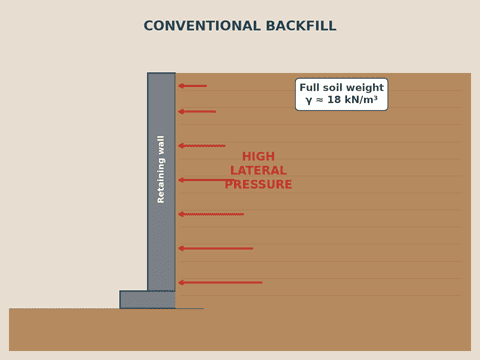
Conventional backfill: full soil weight (γ ≈ 18 kN/m³) drives high lateral pressure across the entire wall.

THE SOLUTION

What Is Geofoam?

Geofoam is a large block of expanded polystyrene (EPS) engineered for civil use as an ultra-lightweight fill material. It looks like a giant foam block but it is a precisely graded, load-rated engineering product that has been used in geotechnical projects worldwide since 1972.
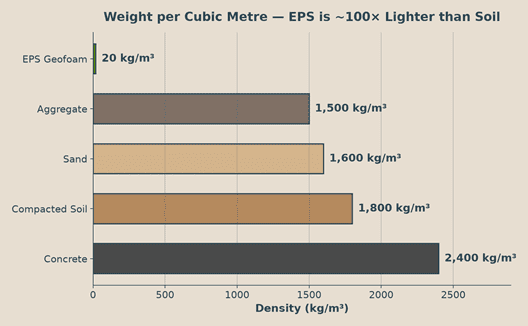
The magic is in the density. A cubic metre of soil weighs around 1,800 kg. A cubic metre of EPS geofoam weighs just 15 to 20 kg nearly 100 times lighter.
Placed behind a retaining wall, Sristi EcoFill™ Geofoam works in one of two ways:
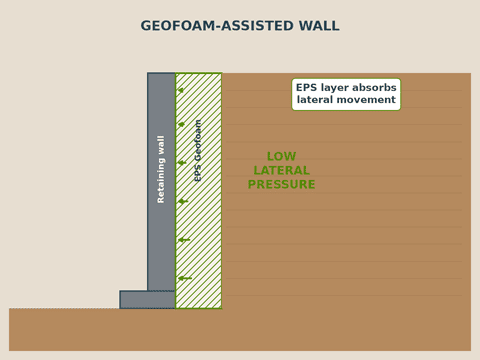
  • As a compressible buffer A thin EPS layer against the wall face compresses slightly and absorbs lateral soil movement dramatically lowering the pressure the wall feels.

  • As a full lightweight replacement Larger EPS blocks replace heavy soil entirely, so there is far less mass pushing on the structure to begin with.
100× 80% 50+ 1972
LIGHTER THAN SOIL
LATERAL LOAD CUT
YEARS SERVICE LIFE
PROVEN SINCE

How It Works

In a conventional wall, soil pushes directly against the concrete along its full height. Introduce a layer of EPS geofoam between the soil and the wall, and that foam layer compresses and absorbs the load instead the wall is shielded from the worst of the pressure.
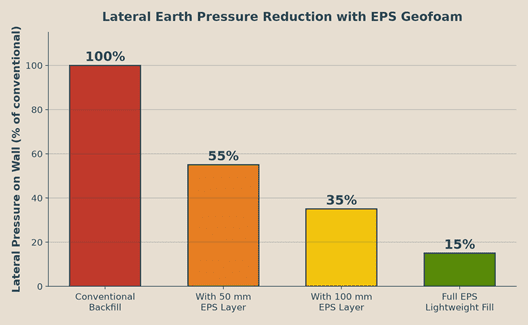
With an EPS layer, lateral pressure on the wall drops sharply.
EPS geofoam is roughly 100× lighter than compacted soil.
BY THE NUMBERS

Just How Much Load Does It Remove?

The load reduction is not marginal, it is transformational. A modest 50–100 mm layer of EPS behind the wall can cut lateral pressure by 45–65%. A full lightweight-fill design can push that reduction all the way to 85%.
why-engineers-switching-5
Lateral earth pressure on the wall, as a percentage of a conventional backfill design.
Why it matters: Less soil weight means less lateral push, less load on the foundation, reduced settlement on soft ground, and a safer structure during earthquakes. Every kilogram you don’t place behind the wall is a kilogram the wall never has to resist.
THE PAYOFF

Key Benefits

  • ↓ 20–40% wall thickness Less soil weight means less lateral push, less load on the foundation, reduced settlement on soft ground, and a safer structure during earthquakes. Every kilogram you don’t place behind the wall is a kilogram the wall never has to resist.

  • ↓ 25–50% steel rebar Lower bending moment means significantly less reinforcement.

  • ↓ 30% foundation size Smaller footings, because the overturning moment drops.

  • 3–5× faster installation Lightweight blocks are handled by hand, no cranes or heavy plants needed.

  • + Thermal insulation (R-value) Basement walls stay drier and warmer, saving energy.

  • 50+ years proven durability Inert, rot-proof and chemically stable when buried.
SIDE BY SIDE

Conventional vs. Sristi EcoFill™

Parameter Conventional With Sristi EcoFill™
Backfill weight

Lateral pressure

Wall thickness

Steel reinforcement

Foundation size

Build speed

Settlement risk

Thermal insulation
1,800 kg/m³

100% (baseline)

Full design

Full design

Full design

Slow — heavy work

High on soft soil

None
15–20 kg/m³

15–55%

20–40% thinner

25–50% less

20–30% smaller

3–5× faster

Very low

Included

Indicative figures – actual savings depend on wall height, soil and design load.

APPLICATIONS

Where To Use It

Basement Walls
Cut hydrostatic and earth pressure on multi-storey basements and gain thermal insulation as a bonus.
Bridge Abutments
Cuts approach-slab settlement and lateral load on abutment walls and piles.
Compound Walls
Reduce load on long boundary walls near slopes or over weak soil.
Hillside Retaining
Ideal for hilly terrain. Reduces wall size on steep, cut-and-fill sites.
Road Embankments
Lightweight fill on soft or reclaimed ground avoids settlement and long consolidation waits.
Wall Retrofit
Excavate, insert EPS, backfill instantly relieve load on aging or overloaded walls.
ON SITE

Typical Installation

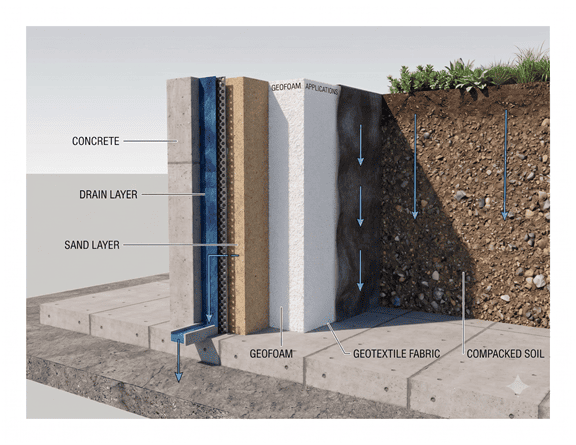
Installation is straightforward and fits neatly into a normal wall construction sequence:
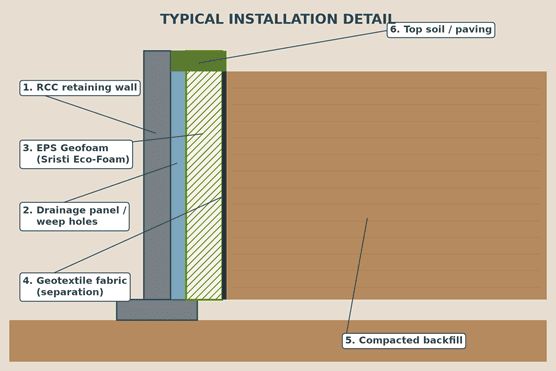
  1. Cast wall + footing – Build the RCC retaining wall and foundation as designed.

  2. Install drainage / weep holes – Manage water behind the wall before the fill goes in.

  3. Stack EcoFill™ blocks – Place EPS geofoam against the wall face handled by hand, no cranes.

  4. Wrap with geotextile – A separation fabric prevents soil intrusion into the fill.

  5. Backfill & compact – Backfill and compact in layers to finish the profile.
why-engineers-switching-6
Typical installation detail – from the RCC wall face out to compacted backfill and paving.
THE PRODUCT

Sristi EcoFill™ Geofoam

Sristi manufactures EPS blocks in-house and cuts them to any size your retaining wall project requires. Every block is produced in accordance with ASTM D6817 / IS 4671 for expanded polystyrene, with density and compressive strength matched to the design load of your wall. Every panel is factory cut, batch tested, and dispatched with test certificates.

Available Grades

Grade Density Comp. Strength Typical Use
EPS-15

EPS-20
15 kg/m³

20 kg/m³
40 kPa

60 kPa
Light backfill

Retaining walls

Standard Panel Sizes

  • Length 4000 mm
  • Width 1200 mm
  • Thickness 100 to 1200mm
  • Custom sizes Cut to your drawings on request.
WHY SRISTI

Why Choose Sristi

  • In-house manufacturing Our own EPS block moulding line no middlemen, full control over density, quality and delivery timelines.
  • Engineering support Our team helps your structural engineer size the EPS layer, select grades, and value-engineer the wall design.
  • Project-ready logistics Panels cut to exact drawings, labelled and stacked for sequenced site delivery, nothing wasted on-site.
  • Proven track record Live projects across South India using our EPS system residential, institutional and commercial.

Build Lighter. Build Smarter.

Talk to us about your next retaining wall, we’ll help you size the EPS layer and value-engineer the design.
www.sristiventures.in     [email protected]   +91 77959 18211
Translate »